
Uncovering Hidden Opportunities in Healthcare
Why Wait Months for the Healthcare Insights You Needed Yesterday?
AskMED.ai™ Leveraging all available healthcare encounters on 300M+ Americans, 2.5M+ PubMed publications, and Atomo’s proprietary patient-finding models (~80% PPV) — through a powerful chat-based interface built on 30 years of healthcare analytics expertise.
“…and what’s the secret sauce?”
AskMED.ai ™ Wins Industry Recognition
AskMED.ai ™ earned the top spot at the AI Trailblazers SXSW in 2024, selected from over 100 AI startup candidates by a panel of distinguished judges.
Read Article >
What’s hurting your critical decision process
Critical healthcare decisions are hindered by slow, incomplete data, and the lack of tools to fully act on insights.
Hidden Undiagnosed Patients
A staggering proportion of patients with specific diseases or conditions remain either undiagnosed or misdiagnosed. The undiagnosed population can range from 15% to 90%, depending on the disease. This results in:
- Poorer health outcomes due to delays in treatment.
- Higher long-term costs for healthcare systems.
- Complications from misdiagnosis, leading to inappropriate treatments and adverse effects.
Download our peer reviewed paper on our Patient Finding Process
The Last Mile
Atomo’s analytics platform leverages real-world data to uncover disparities in patient access and identify populations with unmet medical needs. As demonstrated in peer-reviewed research co-authored by Atomo’s leadership, restricted access to life-saving therapies can significantly increase cardiovascular event rates. These insights drive Atomo’s mission: using advanced analytics to highlight where intervention is most needed—and enabling healthcare systems and BioPharma to act with precision.
This Paper:
- Was downloaded more than 10,000 times in the first 12 months
- Was voted by Circulation as on the 5 highest impact papers of the year
- Resulted in most payers changing their Prior Authorization polices
Minutes Not Months
Discover How Top BioPharma Teams Are Shaving 400+ Days Off Their Strategic Timelines
In an industry where speed and precision are everything, BioPharma leaders are turning to AI-driven solutions to outpace the market. This white paper reveals how AskMED.ai™ is revolutionizing executive decision-making with real-time insights.
Critical Many vs the Vital Few
Discover how less than 7% of HCPs treat over half of all patients with MSA and orthostatic hypotension—insight you can’t afford to overlook.
Download this white paper to learn how Atomo’s AI pinpoints high-impact providers, helping BioPharma teams reduce outreach waste and accelerate market access.
Does this sound familiar?

Diagnostic Challenges
1 in 8 Americans Receives a Misdiagnosis—Many Wait Years for a Correct Diagnosis

Data Driven Decisions
71% of decisions are made without data likely due to traditional analytics taking too long, forcing leaders to rely on intuition rather than evidence

Resource Optimization
~5% of healthcare practitioners will treat 50% of patients with specific diseases or conditions
Your Instant Engine for Healthcare Intelligence.
Stop waiting. Start knowing.
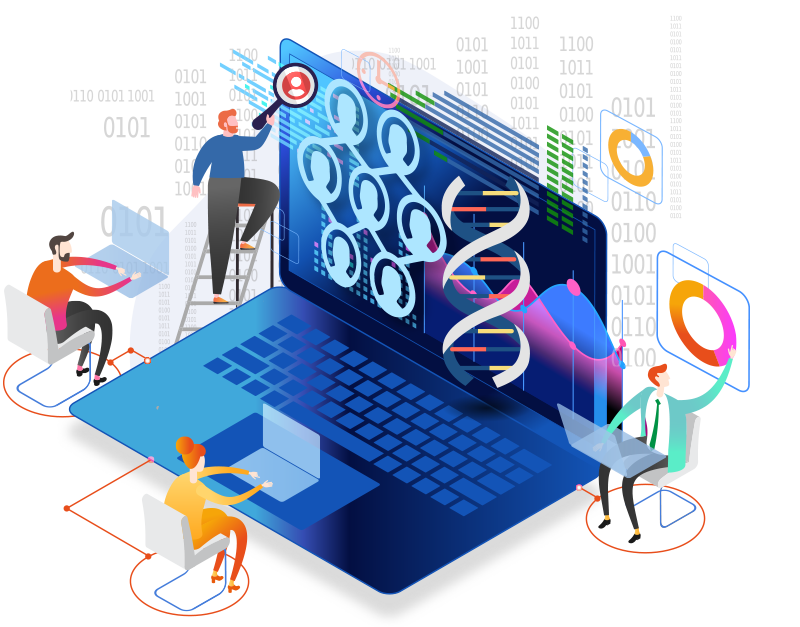
Introducing your instant engine for healthcare intelligence, patient finding, and practitioner engagement. AskMED.ai leverages generative AI, NIH-validated patient finding models and real-time analysis of healthcare encounter data.

YouFind the Unfindable
Proactively identify undiagnosed and misdiagnosed patients with high precision (~80% PPV) to enable earlier interventions and improve outcomes.
Pinpoint the 'Vital Few'
Instantly locate the highest-impact patients and practitioners driving costs, outcomes, and treatment adoption across 80+ diseases.
Accelerate Decisions Dramatically
Transform analysis timelines from months (90-430 days) to mere minutes or days, saving up to a year on strategic initiatives.
Unify Fragmented Intelligence
Get conversational access to integrated insights from healthcare encounters, medical literature, and proprietary models – all in one place.
Drive Efficiency & Innovation
Empower Biopharma, Health Systems, and Clinicians with the clarity needed to optimize resources at the point of care.
Validated by Science.
Trusted by Healthcare Leaders.
Independently Validated
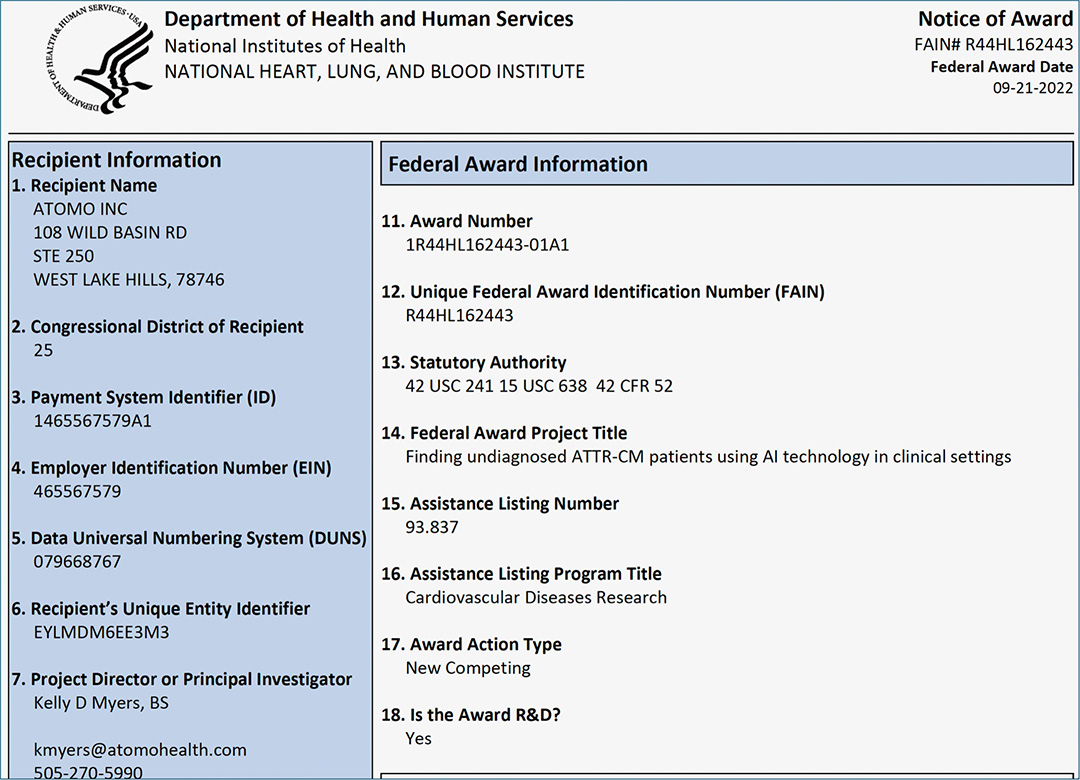
Atomo has served as a key contributor on over five NIH-funded grants focused on advancing AI-based Patient Finding Models across multiple U.S. health systems. Notably, Atomo is the Principal Investigator on a prestigious award from the National Heart, Lung, and Blood Institute, titled “Finding undiagnosed ATTR-CM patients using AI technology in clinical settings” (Award Number: 1R44HL162443-01A1). This R&D-driven project underscores Atomo’s leadership in applying advanced machine learning to identify high-risk, yet undiagnosed patients—bringing earlier intervention and better outcomes to complex cardiovascular conditions.

Peer-Reviewed Validation in Major Medical Journals
Over a dozen peer-reviewed publications in major prestigious medical journals, including; The Lancet Digital Health, Nature Digital Medicine, and Circulation.
Strategic Partnerships with Multiple Healthcare Stakeholders
Discover how Atomo and AstraZeneca are transforming rare disease diagnosis with AI models already deployed in major U.S. and U.K. health systems.
Download this white paper to see how predictive modeling and real-world data are accelerating time-to-diagnosis and empowering earlier intervention.


Powered by Leading Cloud Technology
AskMED.ai™ leverages the robust and scalable infrastructure of Google Cloud ensuring a powerful and safe platform for delivering rapid healthcare insights.
The Atomo / AskMED.ai Difference
From Months of Waiting to Minutes of Knowing
Traditional Analytics
Insight Speed
90 – 400+ Days
Data Access
Siloed, Manual Queries, Static Reports
Patient Finding
Scope
Usability
Requires Data Science Teams
Decision Impact
Reactive, Based on Outdated Info
Atomo / AskMED.ai™
Insight Speed
Minutes – Few Days
Data Access
Patient Finding
Scope
Comprehensive Queries Across All Disease for 300M+ Americans
Usability
Intuitive Conversational Interface
Decision Impact
Proactive, Insight-Empowered Strategy
Advanced Patient Finding Models
Atomo has developed AI models to identify undiagnosed individuals across several diverse medical conditions. Our proprietary process can be applied to any disease/condition. Successful examples to date include but are not limited to:
- ATTR-CM (transthyretin amyloidosis)
- ATTR-PN (polyneuropathies)
- Alpha-1 antitrypsin deficiency
- Ankylosing Spondylitis
- Chronic Granulomatous Disease (CGD)
- Narcolepsy
- Primary Aldosteronism (PA)
- Women’s Hormone Disorder

AskMED.ai ™ Platform
AskMED.ai™ is engineered to deliver rapid, data-driven insights. It significantly reduces data access timelines from months to minutes, enabling more efficient, data-informed decision-making. The platform provides instant conversational access to a vast amount of healthcare data.

Atomo’s patient finding models are being implemented at multiple U.S. and one UK health systems
Enable Timely Interventions
Focus on High Unmet Need Populations
Find Hidden Undiagnosed Patient Populations
Optimize Resource Allocation
Frequently Asked Questions
What are the key healthcare challenges that Atomo's AI solutions address?
Atomo’s AI solutions primarily address the critical healthcare challenges of lack of diagnosis or misdiagnosis, difficulties in healthcare decision-making, and the need to prioritize the vital few individuals who significantly impact healthcare outcomes and costs. We leverage independently validated AI predictive models and our Generative AI-powered platform AskMED.ai™ to tackle these issues.
How does Atomo help identify misdiagnosed and undiagnosed patients?
Atomo’s independently validated AI-powered Patient Finding Solution utilizes machine learning on large-scale healthcare data to identify individuals with specific diseases or conditions who are currently undiagnosed. Our models have demonstrated a high positive predictive value (PPV) of approximately 80% in finding these “hidden patients”. This enables earlier diagnosis and intervention, leading to improved patient outcomes and reduced healthcare costs.
A significant portion of individuals with diseases are often undiagnosed or misdiagnosed, leading to poorer health outcomes and higher healthcare costs. Our solution has been independently validated across several NIH Grants and major peer-reviewed medical journals
What is AskMED.ai™ and how does it improve healthcare decision-making?
AskMED.ai™ is Atomo’s Generative AI-powered platform designed to provide rapid, data-driven healthcare insights. By analyzing vast amounts of data, including healthcare encounter data on over 300 million Americans and over 2.5 million PubMed publications, AskMED.ai™ significantly reduces the time required for analysis from months to minutes or days. This empowers biopharma executives, healthcare practitioners, and health systems to make faster, more informed decisions regarding healthcare priorities, patient management, and treatment strategies.
YourWhat types of data does the AskMED.ai ™ platform analyze?
How quickly can AskMED.ai™ deliver healthcare insights?
AskMED.ai™ delivers healthcare insights with remarkable speed, reducing typical analytics processes from 90 to 430 days down to just seconds to 28 days depending on the complexity of the analysis. This time compression allows for much faster access to critical information and enables timely action.
Who are the primary users of Atomo's solutions?
Atomo’s AI solutions are primarily designed for biopharma executives, healthcare practitioners (physicians), and health systems. Each of these stakeholder groups benefits from Atomo’s ability to provide rapid, data-driven intelligence tailored to their specific needs and challenges.
What does Atomo mean by "Prioritizing the Vital Few" in healthcare?
We also help identify the 5% of healthcare practitioners who treat 50% of the patients with a specific disease. This focus allows for targeted and impactful interventions.
How does Atomo ensure the accuracy and reliability of its AI models, especially its Generative AI?
Our predictive patient finding models are built upon large-scale medical knowledge and real-world evidence, undergoing rigorous validation to ensure high accuracy. Routinely, our patient finding models result in an 70-80% Positive Predictive Value (PPV).
What differentiates Atomo's AI solutions from others in the healthcare AI space?
Has Atomo's technology been validated by external organizations?
Can you provide examples of how Atomo's solutions are used in the real world?
For health systems, our tools help proactively identify at-risk populations, streamline the integration of new clinical guidelines, and enable more effective population health management.
How does Atomo ensure the explainability of its AI insights?
Atomo is committed to providing explainable AI results through transparency, validation, and clinical contextualization. Our AI architecture incorporates interpretable models, provides feature importance analysis, utilizes counterfactual explanations, and offers interactive visualization tools. All models undergo rigorous clinical validation with healthcare professionals. We also provide healthcare-specific AI literacy training and feedback mechanisms to ensure effective interpretation and trust in AI-generated insights.
I am a biopharma executive. How can Atomo help my organization?
As a healthcare practitioner, how can AskMED.ai™ assist me?
AskMED.ai™ enables healthcare practitioners to quickly analyze healthcare encounter data and other medical knowledge to uncover undiagnosed patients and gain timely, personalized insights. This can lead to earlier and more accurate diagnoses, better clinical decisions, and improved patient outcomes. You can ask complex clinical questions in natural language and receive answers in seconds, allowing you to act proactively with your patient population.
How can our health system benefit from partnering with Atomo?
AskMED.ai your question
See what AskMED.ai can do by asking it a business question that has been waiting to be solved. We will send you back a data-driven decision that can make for your business and your career.
Hidden Undiagnosed Patients
Download our peer reviewed paper on our Patient Finding Process
The Last Mile
Download peer reviewed research on Cardiovascular Quality and Outcomes
Minutes Not Months
Empowering BioPharma Executives with Real-Time Market Intelligence
Critical Many vs the Vital Few
Helping BioPharma teams reduce outreach waste and accelerate market access
Strategic Partnerships with Multiple Healthcare Stakeholders
Accelerating Rare Disease Diagnosis Through AI-Powered Integration
- Anurag Verma, PhD, Po Ya Hsu, PhD, Colleen Kripke, MS, William Howard, PhD, Giorgio Sirugo, MD, PhD, and Kelly Myers. Advanced Machine Learning Models for Classifying Transthyretin Amyloidosis in Clinical Settings. Circulation, Volume 150, Number Suppl_1. https://doi.org/10.1161/circ.150.suppl_1.4147767. Originally Published 11 November 2024.
- Kelly D Myers, Joshua W Knowles, MD, David Staszak, PhD, Michael D Shapiro, DO, William Howard, PhD, Mrinal Yadava, MD, David Zuzick, MBA, Latoya Williamson, MS, Nigam H Shah, PhD, Juan M Banda, PhD, Joe Leader, BS, William C Cromwell, MD, Ed Trautman, PhD, Prof Michael F Murray, MD, Seth J Baum, MD, Seth Myers, PhD, Samuel S Gidding, MD, Katherine Wilemon, Prof Daniel J Rader, MD. Precision screening for familial hypercholesterolemia: a machine learning study applied to electronic health encounter data. The Lancet Digital Health, Volume 1, Issue 8, PE393-E402, DECEMBER 01, 2019, DOI: https://doi.org/10.1016/S2589-7500(19)30150-5
- Kelly D. Myers, Niloofar Farboodi, Mkaya Mwamburi, William Howard, David Staszak, Samuel Gidding, Seth J. Baum, Katherine Wilemon, Daniel J. Rader. Effects of access to prescribed PCSK9 inhibitors on cardiovascular outcome. Circulation: Cardiovascular Quality and Outcomes 2019. https://doi.org/10.1161/CIRCOUTCOMES.118.005404.
- Juan M. Banda, Ashish Sarraju, Fahim Abbasi, Justin Parizo, Mitchel Pariani, Hannah Ison, Elinor Briskin, Hannah Wand, Sebastien Dubois, Kenneth Jung, Seth A. Myers, Daniel J. Rader, Joseph B. Leader, Michael F. Murray, Kelly D. Myers, Katherine Wilemon, Nigam H. Shah & Joshua W. Knowles. Finding missed cases of familial hypercholesterolemia in health systems using machine learning. npj Digital Medicine 2019. https://doi.org/10.1038/s41746-019-0101-5.
- Kelly D. Myers, Katherine Wilemon, Mary P. McGowan, William Howard, David Staszak, Daniel J. Rader. COVID-19 associated risks of myocardial infarction in persons with familial hypercholesterolemia with or without ASCVD. American Journal of Preventive Cardiology. 7 (2021) 100197.
- Joshua W Knowles, William B. Howard, Lala Karayan, Seth J Baum, Katherine A. Wilemon, Christie M Ballantyne, Kelly D Myers. Access to Non-Statin Lipid Lowering Therapies in Patients at High-Risk of Atherosclerotic Cardiovascular Disease. Circulation. 2017 April 26. PMID: 28446516. DOI: 10.1161/CIRCULATIONAHA.117.027705.
- Arlene E Chung, Robert S Sandler, Millie D Long, Sean Ahrens, Jessica L Burris, Christopher F Martin, Kristen Anton, Amber Robb, Thomas P Caruso, Elizabeth L Jaeger, Wenli Chen, Marshall Clark, Kelly Myers, Angela Dobes, Michael D Kappelman. Harnessing person-generated health data to accelerate patient-centered outcomes research: the Crohn’s and Colitis Foundation of America PCORnet Patient Powered Research Network (CCFA Partners). Journal of the American Medical Informatics Association, Volume 23, Issue 3, 1 May 2016, Pages 485–490, https://doi.org/10.1093/jamia/ocv191.
- Arlene E. Chung ; Maihan Vu ; Jessica Burris ; Kelly Myers ; Michael D. Kappelman. Patient Perspectives on Designing an Engaging Patient-Powered Research Network Patient Portal: Crohn’s and Colitis Foundation of America (CCFA) PartnersAMIA 2016, American Medical Informatics Association Annual Symposium, Chicago, IL, USA, November 12-16, 2016. AMIA 2016. 2016-11-12. | conference-paper. OTHER-ID: amia-63300
- Welmoed K. van Deen, MD, Martijn G. H. van Oijen, PhD, Kelly D. Myers, BS, Adriana Centeno, BA, William Howard, PhD, Jennifer M. Choi, MD, Bennett E. Roth, MD, Erin M. McLaughlin, BS, Daniel Hollander, MD, Belinda Wong-Swanson, PhD, Jonathan Sack, MD, Michael K. Ong, MD, PhD, Christina Y. Ha, MD, Eric Esrailian, MD, MPH, Daniel W. Hommes, MD, PhD. A Nationwide 2010–2012 Analysis of U.S. Health Care Utilization in Inflammatory Bowel Diseases. Inflammatory Bowel Diseases, Volume 20, Issue 10, 1 October 2014, Pages 1747–1753, https://doi.org/10.1097/MIB.0000000000000139. 18 August 2014.
- Long MD, Hutfless S, Kappelman MD, Khalili H, Kaplan G, Bernstein CN, Colombel JF, Gower-Rousseau C, Herrinton L, Velayos F, Loftus EV, Nguyen GC, PhD, Ananthakrishnan AN, Sonnenberg A, Chan A, Sandler RS, Atreja A, Shah SA, Rothman K, Leleiko NS, Bright R, Boffetta P, Myers KD, Sands BE. Challenges in Designing a National Surveillance Program for Inflammatory Bowel Disease in the United States. Inflamm Bowel Dis. PMID:24280882 PMCID: PMC4610029. DOI: 10.1097/01.MIB.0000435441.30107.8b
- Hommes, D. W.; Esrailian, E; Wong-Swanson, B; Centeno, A; McLaughlin, E.M.; Howard, W; Choi, J. M.; Myers, K. D.; van Oijen, M. G. Preparing for the Affordable Care Act in Inflammatory Bowel Diseases: a 2010-2012 US insurance claims analysis. Digestive Disease Week 2013. DOI:10.1016/S0016-5085(13)60638-1